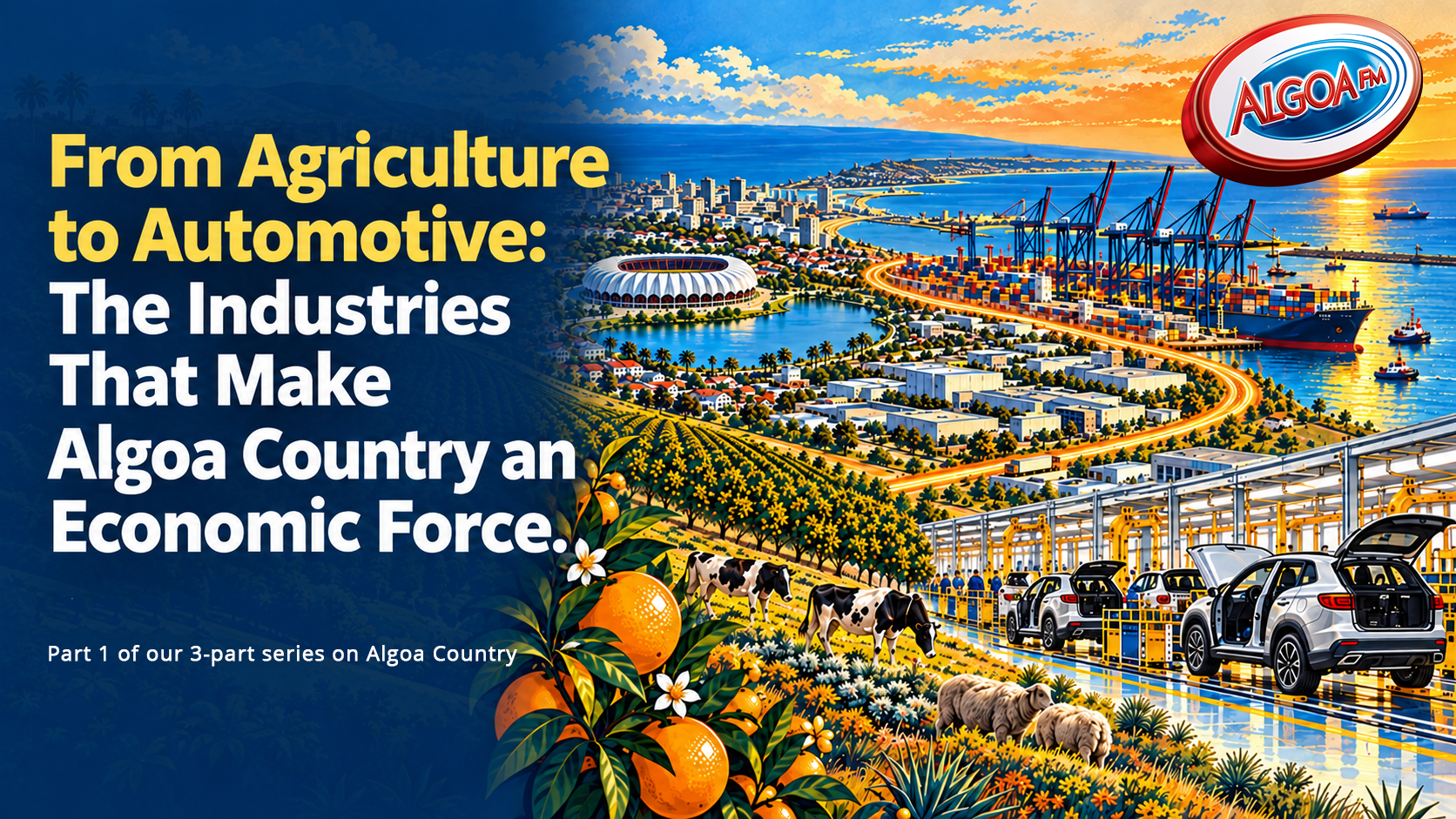
Part 1 – Business: See what powers the region.
There is a golden thread running through Algoa Country, connecting the things we make, the places we live, the experiences we share, and the natural resources that sustain us. We explore this golden thread through the lens of business, lifestyle, and sustainability, revealing the people, places, industries, and ideas that make Algoa Country such a distinctive part of South Africa.
From the cars South Africans drive to the citrus they export, the dairy in their morning coffee, and the wind power shaping the country’s energy future, Algoa Country is quietly powering some of South Africa’s biggest industries.
Stretching from the Garden Route through the Eastern Cape to the Wild Coast, and inland through the Karoo, the footprint has become a strategic economic corridor where automotive manufacturing, agriculture, logistics, renewable energy, and tourism converge, attracting billions of rands in investment and cementing its role as one of the country’s most influential business ecosystems.
Seventy-five years of ‘the people’s car’ and other vehicles
Since the first VW Beetle rolled out of the plant in Kariga (formerly Uitenhage), in August 1951, Volkswagen (the people’s car), has woven itself into the fabric of local daily life, popular culture, and the domestic automotive economy.
It’s not surprising that Algoa Country is positioned at the centre of South Africa’s automotive industry. Since that first beloved Beetle kicked off a 75-year history of vehicle manufacturing in the Eastern Cape, Kariga became the sole global assembler of the VW Polo, with more than one million cars produced. Now, Volkswagen Group Africa has invested R4 billion ahead of the launch of the Tengo, a new car developed by engineers and designers from Algoa Country and Brazil.
Isuzu Motors SA has reported a record-breaking 2025/26, with production up 21% year-on-year. The Nelson Mandela Bay plant has produced 27,400 D-Max bakkies and 3 800 commercial trucks. Underlining the importance of the brand, VSL Manufacturing is investing R750 million in a new stamping facility to support Isuzu production.
With Mercedes-Benz South Africa, FAW Trucks South Africa, BAIC South Africa, and Ford Motor Company of Southern Africa’s engine plant all operating in Algoa Country, it’s no surprise that around 70% of South Africa’s automotive component manufacturers are based in, or linked to, the region.
Then there’s agriculture and agri-business
Agriculture, forestry, and fishing, are major contributors to Gross Domestic Product, contributing R13.5 billion to regional GDP in 2024, up from R11.7 billion the previous year.
The Eastern Cape produces approximately 60% of South Africa’s lemons, helping to ensure South Africa’s position as the world’s largest citrus exporter in the 2025 season.
The area is home to 25% of South Africa’s beef herd (around three million cattle), produces 30% of our dairy milk, and annually supplies a whopping nine million kilograms of cheese to Famous Brands’ franchises such as Steers, Wimpy and Debonairs.
The arid Karoo produces 34% of South Africa’s wool clip and 42% of the world’s mohair. The Eastern Cape also competes with the Northern Cape for top lamb and mutton production.
Although the Cape Winelands is the heart of South African wine, the Plett Winelands includes approximately 16 boutique wine farms.
Trade connections
Algoa Country is one of South Africa’s most connected trade corridors, with four commercial ports, a useful asset considering the volume of exports leaving South Africa from the area.
The Port of Ngqura is the deepest container port in Sub-Saharan Africa, while the Port of Gqeberha is a major export and import gateway. The port in Mossel Bay, not surprisingly, supports a petroleum sector centred around the state-owned PetroSA Gas-to-Liquids (GTL) refinery. The local industry involves offshore extraction, fuel storage and specialised engineering support services.
The Port of East London is linked to the city’s Special Economic Zone, supporting industries such as automotive, agriculture, bulk cargo, and dry dock services.
Ports are ripe for investment, highlighted by MSC Logistics’ R500 million investment to expand maritime and logistics infrastructure around the Ngqura and East London ports.
The area’s road and rail corridors integrate the region into national supply chains, positioning it as a strategic location for import, export, and distribution businesses.
Strategic advantages
From manufacturing and agriculture to logistics, tourism, and renewable energy, Algoa Country’s economic strength lies in the diversity and interconnectedness of its industries. With established infrastructure, natural resources, skilled businesses, and significant investment underway, the region is not simply contributing to South Africa’s economy, but is helping to shape its future.
Follow the full three-part series for your chance to WIN and experience Algoa Country for yourself!
Part 1 – Business: See what powers the region.
Part 2 – Sustainability: See what protects its future.
Part 3 – Lifestyle: See what makes you want to stay.
READ IT. DISCOVER IT. EXPERIENCE IT.
For more information contact Candy Dempers, Commercial Manager Algoa FM and OFM