Part 2 – Sustainability: See what protects its future
There is a golden thread running through Algoa Country, connecting the things we make, the places we live, the experiences we share, and the natural resources that sustain us. We explore this golden thread through the lens of business, lifestyle, and sustainability, revealing the people, places, industries, and ideas that make Algoa Country such a distinctive part of South Africa.
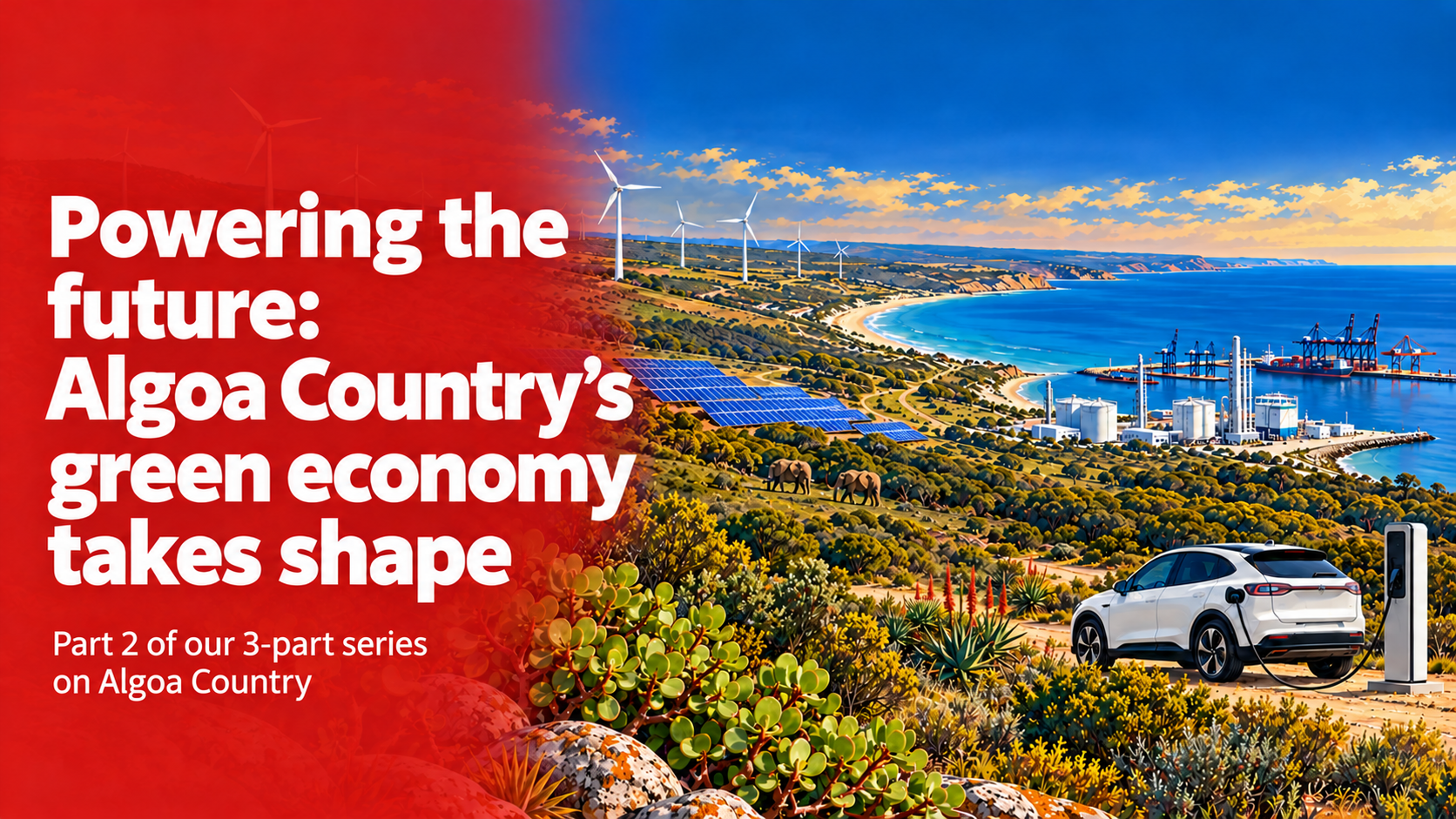
From wind farms and solar parks to spekboom restoration, green hydrogen, and electric mobility, Algoa Country is turning its natural advantages into an engine for sustainable growth.
Across the region, billions of rands are flowing into renewable energy, carbon removal, clean transport, and eco-industrial development, while its coastline, protected landscapes, and agricultural heritage underpin a growing nature economy.
This is sustainability with ambition: not simply protecting what exists, but using natural resources, innovation, and infrastructure to build a cleaner, more resilient economy.
Renewable energy powers growth
The Eastern Cape has 15 utility-scale wind and solar farms generating renewable electricity, with additional projects under construction or in development.
Enel Green Power has invested R9.8 billion to expand wind energy infrastructure through the Impofu Wind Farm Cluster, while Parsons Power Park has raised R2.8 billion for a large-scale solar energy project on the outskirts of Nelson Mandela Bay.
Amazon has also announced a major R8 billion nature-based carbon removal programme in Algoa Country. The global technology company has committed to buying 1.95 million carbon removal credits from a 50 000-hectare ecological restoration project in Jansenville in the Sarah Baartman District.
Led by ecosystem restoration, a company imperative, the initiative envisages 180 million indigenous spekboom cuttings planted by the end of 2028, removing almost two million tonnes of carbon dioxide from the atmosphere. The indigenous succulent captures carbon at rates comparable to young tropical forests, while restoring soil moisture and supporting the return of native flora, birds, and insects.
The project is also expected to generate an estimated 11 000 jobs by 2030, creating opportunities for rural communities while restoring biodiversity and strengthening the region’s emerging nature-based economy.
Coega targets the green hydrogen economy
The Coega Special Economic Zone is emerging as a key hub in South Africa’s ambitions to develop a green hydrogen economy, with the zone positioned as a potential gateway for hydrogen processing and clean-energy exports.
Green hydrogen could open new opportunities in energy-intensive manufacturing and export markets, supporting the region’s transition towards a lower-carbon industrial economy.
Electric mobility finds its testing ground
Algoa Country is also expanding infrastructure for electric mobility as demand grows for cleaner transport and low-carbon logistics. Between January and February 2026, Rubicon installed 11 new EV charging stations across the Eastern Cape, nine offering DC fast charging, through a partnership with the Automotive Industry Development Centre (AIDC).
A further 29 charging stations are planned across Algoa Country through the Zero Carbon Charge network, supporting both passenger vehicles and commercial trucks.
Established in 2013 the Nelson Mandela University’s uYilo unit serves as the national electric mobility programme and plays a leading role in enabling the electric mobility ecosystem. As a multi-stakeholder programme, uYilo’s activities include government lobbying, industry engagement , pilot projects, capacity development, enterprise development and thought leadership across the ecosystem.
Algoa Country’s Blue Economy opportunity
With more than 800km of coastline, Algoa Country is well positioned to benefit from Africa’s growing Blue Economy. Aligned with South Africa’s Operation Phakisa strategy, the region’s marine resources offer opportunities across ocean industries, marine logistics, commercial fishing, coastal tourism, and maritime services.
The challenge is to turn these coastal assets into jobs, investment, and long-term economic value while protecting the marine environment on which these industries depend.
Conservation drives the nature economy
Algoa Country’s biodiversity is another major asset, with five national parks, around 30 provincial nature reserves, and more than 33 private game reserves protecting indigenous forests, Karoo ecosystems, coastal habitats, rivers, and wetlands.
These natural attractions support a growing eco-tourism economy, from 27 Blue Flag beaches and wildlife experiences, to hiking, birding, and marine activities. Conservation therefore has the potential to support jobs and investment while protecting the region’s environmental heritage.
Research and innovation underpin growth
Research and innovation are also supporting the Eastern Cape’s sustainability ambitions. Nelson Mandela University, Rhodes University, the University of Fort Hare, and Walter Sisulu University, contribute to environmental research, development, and innovation.
Their work is complemented by the Science and Technology Park at the East London Industrial Development Zone, as well as clinical and agricultural research institutions across the region.
Together, these initiatives reveal a region where sustainability is becoming an engine of economic growth rather than simply classifying hope as an environmental imperative.
Follow the full three-part series for your chance to WIN and experience Algoa Country for yourself!
Part 1 – Business: See what powers the region.
Part 2 – Sustainability: See what protects its future.
Part 3 – Lifestyle: See what makes you want to stay.
READ IT. DISCOVER IT. EXPERIENCE IT.
For more information contact Candy Dempers, Commercial Manager Algoa FM and OFM